
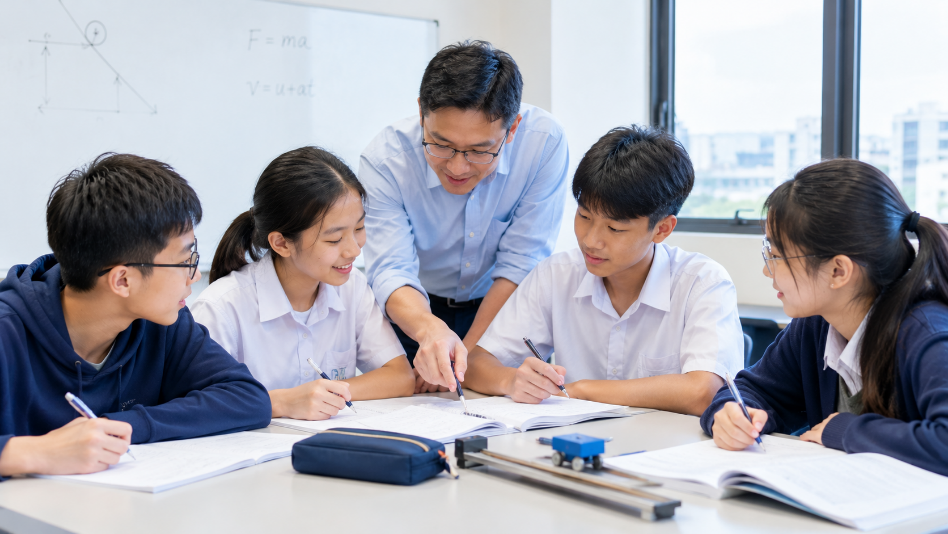
Choosing the right JC Physics tuition Singapore programme can help students understand challenging concepts, develop stronger problem-solving skills, and prepare more effectively for examinations. Physics is an important subject for students pursuing science-related pathways, yet many find it difficult because it combines mathematical calculations, abstract theories, experimental skills, and analytical reasoning. Since 1999, SmartLab Tuition Centre has supported students through structured, results-driven tuition, experienced full-time tutors, small class sizes, and personalised academic guidance. With centres in Bishan, Kovan, Marine Parade, and Woodlands, SmartLab provides Physics tuition in Singapore for students at different academic levels, from secondary school to Junior College and A-Level preparation.
What Is Physics Tuition in Singapore?
Physics tuition is supplementary academic instruction that helps students understand scientific principles, apply mathematical methods, interpret experimental data, and solve examination questions accurately. Unlike revision based only on memorising formulas, effective Physics tuition develops the reasoning skills students need to apply concepts to unfamiliar situations.
In Singapore, Physics students encounter topics such as motion, forces, energy, waves, electricity, magnetism, and thermal physics. As students progress to Junior College, the subject becomes more mathematically demanding and requires deeper conceptual understanding.
Therefore, choosing a suitable Physics tuition programme can help learners address knowledge gaps, practise challenging questions, and develop effective examination techniques.
At SmartLab Tuition Centre, lessons use activity-based and problem-based learning to strengthen conceptual understanding and critical thinking. Students are guided through individual concepts before applying their knowledge to different types of questions. This structured approach helps them recognise relationships between theories, calculations, and real-world applications.
Whether a student needs secondary Physics tuition, H2 Physics tuition, or A-Level Physics tuition, the programme should match their academic level, learning needs, and examination requirements.
Why Is Physics Tuition Important for Students in Singapore?
Physics can be challenging because students must understand both what happens in a physical system and why it happens. They must also translate information into diagrams, equations, graphs, and written explanations.
For example, a question about a moving object may require students to interpret a velocity-time graph, calculate acceleration, apply Newton’s laws, and explain the effect of a resultant force. Consequently, memorising a formula without understanding its meaning may not be enough.
Structured Physics tuition can help students overcome these difficulties in several ways.
1. Build a Strong Understanding of Physics Concepts
Students need to understand the principles behind formulas before applying them. For instance, learning about conservation of energy becomes easier when students can explain how energy changes between kinetic, gravitational potential, and other forms.
Similarly, understanding electric circuits requires more than remembering equations for current, voltage, and resistance. Students must recognise how these quantities relate to one another in different circuit arrangements.
Through guided explanations and targeted exercises, Physics tuition can help learners build these conceptual connections.
2. Improve Mathematical Application and Problem-Solving Skills
Physics questions frequently involve calculations, unit conversions, rearranging equations, and interpreting numerical information.
However, many students lose marks because they select the wrong formula, overlook a unit, or fail to identify the relevant physical principle.
An effective Physics tutor teaches students to analyse the question, identify known and unknown quantities, choose an appropriate method, and show their working clearly. Furthermore, regular practice helps students recognise common question patterns without relying entirely on memorisation.
3. Develop Examination Techniques
Understanding a topic is only one part of examination preparation. Students must also interpret command words, manage time, present calculations clearly, and explain scientific principles accurately.
For example, a calculation question may require a formula, substitution, working, and a final answer with the correct unit. In contrast, an explanation question may require a clear sequence of cause and effect.
Therefore, Physics tuition should develop both subject knowledge and the ability to communicate answers in the format expected by the applicable assessment.
4. Strengthen Confidence and Independent Learning
Students sometimes avoid difficult questions because they fear making mistakes. However, mistakes can reveal gaps in understanding and provide opportunities for improvement.
With constructive feedback, learners can identify why an answer is incorrect and practise the relevant concept again. Over time, this process encourages independent thinking and more systematic revision.
Why Choose SmartLab Physics Tuition Centre Singapore?
When comparing Physics tuition centres in Singapore, parents should consider teaching experience, lesson structure, class environment, examination preparation, and the amount of individual support available.
SmartLab Tuition Centre has been providing tuition since 1999, with programmes covering Mathematics, Science, English, General Paper, and Humanities. Its Physics tuition focuses on conceptual understanding, guided practice, problem-solving, and preparation for school assessments and national examinations.
Experienced Full-Time Tutors
Experienced tutors can help students work through difficult topics and understand how different Physics principles connect.
At SmartLab, tutors provide academic guidance and help students clarify concepts that may be difficult to grasp independently. In addition, students can practise applying these concepts through structured questions and receive feedback on their approach.
Small Classes and Personalised Attention
Students do not always struggle with the same aspects of Physics. One may need help with mechanics, while another may find electricity, waves, or data interpretation more difficult.
Small class sizes create opportunities for students to ask questions, participate in lessons, and receive more individual attention. Consequently, tutors can help learners identify specific weaknesses and focus on areas that require further practice.
Activity-Based and Problem-Based Learning
Physics becomes easier to understand when students connect scientific principles with practical situations.
SmartLab’s activity-based and problem-based learning approach encourages students to engage with concepts and apply them to questions. Rather than simply memorising equations, learners are guided to understand why a particular method works and when it should be used.
Structured Practice and Examination Preparation
Students need regular practice to develop accuracy and speed. SmartLab’s Physics teaching approach breaks concepts into manageable sections before introducing different types of questions, including multiple-choice and structured problems where appropriate to the student’s level.
Moreover, students can strengthen their understanding by reviewing mistakes, practising calculations, and learning how to present explanations clearly.
Four Convenient Locations in Singapore
SmartLab operates in:
- Bishan: An option for students from Bishan and surrounding neighbourhoods.
- Kovan: Convenient for students travelling from Kovan, Hougang, and nearby areas.
- Marine Parade: Suitable for families in Marine Parade and neighbouring eastern areas.
- Woodlands: An option for students from Woodlands and nearby northern neighbourhoods.
These locations give families greater flexibility when choosing a Physics tuition centre that fits their daily routine.
Secondary Physics Tuition Singapore: Build Strong Foundations
Secondary school is an important stage for developing the fundamental concepts and mathematical skills needed for more advanced Physics.
Students encounter principles involving motion, forces, energy, thermal processes, waves, and electricity, depending on their subject combination and syllabus. They must also learn how to apply scientific reasoning rather than simply reproduce textbook definitions.
Secondary Physics tuition can help learners strengthen these foundations through guided explanations, targeted exercises, and examination-style practice.
Topics Covered in Secondary Physics Tuition
Depending on the student’s school syllabus and academic level, important areas may include:
- Motion and forces: Speed, velocity, acceleration, Newton’s laws, and resultant forces.
- Energy and power: Work done, energy transfers, efficiency, and power.
- Thermal physics: Temperature, heat transfer, and changes in internal energy where applicable.
- Waves: Wave properties, reflection, refraction, and other relevant wave phenomena.
- Electricity: Current, potential difference, resistance, and electrical circuits.
- Magnetism and electromagnetism: Magnetic fields and their applications, where included in the syllabus.
- Experimental skills: Measurements, graphs, variables, uncertainty, and practical investigation techniques as required.
The precise topics depend on the student’s course and current examination syllabus.
How Secondary Physics Tuition Helps Students Improve
A common difficulty is applying a familiar formula to a question presented in an unfamiliar way. Students may understand a worked example but struggle when the question changes the diagram, gives additional information, or asks for an explanation.
To address this, students should practise interpreting diagrams, identifying relevant information, selecting suitable equations, and explaining their reasoning.
Furthermore, regular feedback helps them recognise recurring mistakes, such as incorrect unit conversions, unclear working, or confusing distance with displacement.
Students and parents searching for SEC Physics tuition Singapore should first confirm the applicable Secondary Education Certificate examination pathway and syllabus for their cohort. Tuition should match the actual school curriculum and assessment requirements rather than rely on an assumed examination format.
JC Physics Tuition Singapore: Prepare for Advanced Physics
Junior College Physics requires students to develop a deeper understanding of physical principles and apply mathematical reasoning to more complex problems.
For students taking H1 or H2 Physics, concepts become increasingly interconnected. A question may require several steps of reasoning, careful interpretation of information, and accurate calculations before reaching the final answer.
JC Physics tuition can provide additional support for students who need to strengthen their foundations, improve their approach to structured questions, or prepare more systematically for A-Level examinations.
What Does JC Physics Tuition Cover?
The precise content depends on whether the student takes H1 or H2 Physics and on the applicable Singapore-Cambridge A-Level syllabus.
Common areas in JC Physics include:
- Mechanics: Kinematics, dynamics, momentum, forces, and energy.
- Circular motion and oscillations: Relevant motion models and their mathematical applications.
- Gravitational fields: Field strength, potential, and associated physical relationships where prescribed.
- Electricity: Electric fields, potential, current, and circuit principles.
- Magnetic fields: Magnetic forces and related applications.
- Waves: Wave behaviour, superposition, and other syllabus-specific concepts.
- Thermal physics: Thermal processes and the relevant microscopic or macroscopic models.
- Quantum and nuclear physics: Modern physics concepts covered by the applicable syllabus.
- Practical and data-analysis skills: Experimental methods, graph interpretation, uncertainty, and evaluation where assessed.
Not every topic appears in every Physics course. Therefore, students should check their syllabus before selecting a revision programme.
How Physics JC Tuition Improves Problem-Solving Skills
At JC level, students often need to connect multiple principles within one question. For instance, a mechanics problem may require them to analyse forces, apply Newton’s second law, and then use an equation of motion.
A systematic approach can make such questions more manageable.
First, identify what the question asks. Next, extract the relevant information and represent the physical situation with a diagram where appropriate. Then select the governing principle, show the necessary working, and check whether the final answer is physically reasonable.
With consistent practice, students can become more confident in handling unfamiliar questions and explaining the reasoning behind their calculations.
JC H2 Physics Tuition for Challenging Topics
H2 Physics generally demands substantial mathematical application and conceptual reasoning. Students may find it difficult to connect abstract principles with diagrams, equations, graphs, and experimental observations.
JC H2 Physics tuition should therefore emphasise understanding, application, and structured practice. Rather than memorising isolated solutions, students need to learn how to adapt their knowledge to different situations.
For example, when studying electric fields, they should understand the relationship between field strength, force, charge, and potential where relevant. Similarly, in mechanics, they should be able to connect motion, forces, momentum, and energy instead of treating each topic as completely separate.
This deeper understanding supports more flexible problem-solving.
H2 Physics Tuition Singapore: What Should Students Look For?
When choosing H2 Physics tuition Singapore, students and parents should look for a programme that addresses the specific demands of the H2 syllabus and provides enough opportunities to practise complex questions.
Conceptual Understanding Before Formula Memorisation
Formulas are important, but students need to understand the assumptions and relationships behind them.
For example, an equation may apply only under particular conditions. Recognising those conditions helps students decide whether the equation is appropriate for a given question.
Consequently, a good H2 Physics tuition centre should explain concepts clearly and demonstrate how they apply to different problem types.
Structured Questions and Higher-Order Thinking
Advanced Physics questions may require several connected steps rather than a single calculation.
Students should practise identifying the relevant principle, explaining their method, and showing clear working. In addition, they should review incorrect answers to understand whether the underlying issue involves conceptual understanding, mathematical accuracy, or question interpretation.
Data Analysis and Experimental Skills
Physics examinations may assess students’ ability to interpret graphs, analyse experimental data, evaluate uncertainties, and explain limitations in a practical investigation.
These skills require practice beyond memorising definitions.
Students should learn how to identify trends, interpret gradients where appropriate, use units consistently, and support conclusions with evidence. Where practical assessment is part of the syllabus, they should also understand measurement procedures and common sources of experimental error.
H1 and H2 Physics: Choose the Appropriate Programme
H1 and H2 Physics have different course requirements. Therefore, tuition should reflect the student’s actual subject combination and syllabus.
Before enrolling, confirm that the programme covers the relevant topics, assessment format, and level of mathematical detail. This is particularly important when preparing for school examinations or the Singapore-Cambridge A-Level examinations.
A-Level Physics Tuition Singapore: Effective Examination Preparation
A-Level Physics tuition Singapore is designed to support students preparing for demanding pre-university Physics assessments.
At this level, students benefit from a balance of conceptual revision, topical exercises, mixed-topic questions, and timed practice. Each type of preparation serves a different purpose.
Topical practice helps identify weaknesses in individual chapters. Mixed-topic exercises test whether students can recognise which principles apply without being told the topic in advance. Timed papers, meanwhile, help learners practise managing examination time.
How to Prepare for A-Level Physics
A structured revision routine can make preparation more effective.
Step 1: Identify weak topics. Review past tests and practice questions to determine where errors occur most often.
Step 2: Revisit the underlying concepts. Understand the principles before attempting increasingly difficult questions.
Step 3: Practise topical questions. Apply the concepts and review each mistake carefully.
Step 4: Attempt mixed-topic questions. Learn to identify relevant principles when the topic is not stated explicitly.
Step 5: Complete timed practice. Develop a realistic sense of how much time to allocate to different questions.
Step 6: Review answers systematically. Check calculations, units, diagrams, explanations, and the relevance of each step.
This process helps students make their revision more targeted and productive.
Why Choose an A-Level Physics Tuition Centre?
An A-Level Physics tuition centre can provide structured lessons, guided practice, and feedback that complement school learning.
When comparing providers, consider tutor experience, syllabus alignment, class size, learning materials, and the opportunities available for asking questions. Additionally, make sure the programme addresses the student’s actual needs rather than providing revision that duplicates topics they already understand well.
SmartLab’s approach emphasises breaking concepts into manageable sections and allowing students to practise applying those concepts. This can be useful for learners who need a more systematic way to approach challenging Physics questions.
How to Choose the Best Physics Tuition in Singapore
Parents searching for the best Physics tuition Singapore should compare providers based on teaching quality, suitability, and learning support rather than relying on promotional claims alone.
Check Tutor Experience and Teaching Methods
Look for tutors who can explain concepts clearly, respond to questions, and help students understand why a method works.
A good teaching approach should combine explanation, demonstration, practice, and feedback. Moreover, the tutor should be able to adapt explanations when a student does not understand a concept immediately.
Confirm Syllabus Alignment
The programme should match the student’s school level, subject combination, and current examination requirements.
For secondary learners, this may mean checking the relevant school Physics syllabus. For JC students, confirm whether the programme is suitable for H1 or H2 Physics.
Ask About Class Size and Feedback
Small classes can provide more opportunities for individual support. Parents should also ask how tutors identify learning gaps and whether students receive guidance on recurring mistakes.
Compare Learning Materials and Practice
Useful resources may include topic summaries, worked examples, structured questions, multiple-choice exercises, and examination-style practice.
However, the quality of the teaching and the relevance of the materials matter more than the quantity of worksheets provided.
Consider Location and Schedule
Regular attendance is easier when tuition fits the student’s school timetable and travel arrangements.
SmartLab operates in Bishan, Kovan, Marine Parade, and Woodlands. Families can compare these locations with their daily routines and confirm the available class schedules before enrolling.
Physics Tuition Near Me: Find a Convenient SmartLab Centre
Searching for Physics tuition near me usually means looking for suitable academic support within a reasonable travelling distance. SmartLab offers four locations for families considering secondary, JC, and A-Level Physics tuition.
Physics Tuition in Bishan
The Bishan centre is an option for students living or studying in Bishan and nearby neighbourhoods. Families can consider it when looking for regular Physics lessons that fit their schedules.
Physics Tuition in Kovan
The Kovan centre serves students travelling from Kovan, Hougang, and surrounding areas. Its location can be convenient for families seeking Physics tuition in Singapore’s north-east.
Physics Tuition in Marine Parade
Students from Marine Parade and nearby eastern neighbourhoods can consider the Marine Parade centre when comparing suitable tuition locations.
Physics Tuition in Woodlands
The Woodlands centre provides another option for students living in the north of Singapore, including families in and around Woodlands.
Before making a decision, contact SmartLab to confirm the available Physics classes, fees, timetables, and programme suitability.
How Students Can Improve Their Physics Results
Tuition can provide structure and guidance, but progress also depends on consistent independent practice.
Students can strengthen their Physics skills by developing the following habits.
Understand the concept first. Before memorising an equation, explain what the variables represent and when the equation applies.
Draw diagrams where useful. Force diagrams, circuit diagrams, and other representations can make complex situations easier to analyse.
Show your working. Writing down the steps makes it easier to identify mistakes and communicate the reasoning behind an answer.
Use units consistently. Check that quantities are expressed in compatible units before performing calculations.
Practise explaining scientific principles. For qualitative questions, use accurate scientific language and connect causes with their effects.
Review mistakes rather than simply checking scores. Identify whether an error resulted from a misunderstanding, an incorrect formula, a calculation mistake, or a misreading of the question.
Use timed practice strategically. Once the concepts are understood, timed exercises can help develop examination speed and time management.
Together, these habits encourage independent learning and help students make better use of the support they receive in Physics tuition.
Why Parents Choose SmartLab Tuition Centre
Since 1999, SmartLab Tuition Centre has been committed to supporting students through structured, results-driven tuition. Its programmes cover Mathematics, Science, English, General Paper, and Humanities, helping learners develop academic knowledge and practical learning skills.
SmartLab’s Physics tuition combines activity-based and problem-based learning with small class sizes and guidance from experienced full-time tutors. Students are encouraged to understand concepts, ask questions, practise different types of problems, and learn from their mistakes.
Furthermore, the centre recognises that students have different academic goals. Some need to strengthen foundational Physics concepts, while others require more advanced H2 or A-Level examination preparation.
By selecting a programme that matches the student’s level and learning needs, families can make tuition a more focused part of their academic routine.
Frequently Asked Questions About Physics Tuition in Singapore
1. How much does Physics tuition cost in Singapore?
Physics tuition fees vary according to academic level, class size, lesson frequency, tutor experience, and programme structure. Parents should contact the tuition centre for current fees and compare the teaching approach, learning support, and schedule before enrolling.
2. What is the difference between secondary Physics tuition and JC Physics tuition?
Secondary Physics tuition focuses on foundational principles and their application to school-level questions. In contrast, JC Physics tuition covers more advanced concepts and mathematical reasoning, with preparation tailored to H1 or H2 Physics and the applicable A-Level syllabus.
3. Is H2 Physics tuition necessary for JC students?
H2 Physics tuition is not necessary for every student, but it can help learners who struggle with difficult concepts, complex calculations, data analysis, or examination techniques. A suitable programme provides additional explanations, structured practice, and feedback to address individual learning gaps.
4. How do I choose the best Physics tuition centre in Singapore?
Compare tutor experience, class size, teaching methods, syllabus alignment, learning materials, and opportunities for personalised feedback. Also, consider the centre’s location and timetable. The most suitable programme is one that addresses the student’s weaknesses and supports consistent learning.
5. Where can I find JC Physics tuition near me in Singapore?
SmartLab Tuition Centre operates in Bishan, Kovan, Marine Parade, and Woodlands. Students and parents can consider the most convenient branch and contact the centre to confirm available JC Physics classes, current fees, schedules, and whether the programme covers H1 or H2 Physics.
Conclusion: Find the Right JC Physics Tuition Singapore Programme
Physics success depends on more than memorising equations. Students need to understand scientific principles, apply mathematical reasoning, interpret data, and communicate their working clearly. With consistent practice and suitable guidance, they can address learning gaps and develop a more systematic approach to challenging questions.
Since 1999, SmartLab Tuition Centre has supported students through structured tuition, activity-based and problem-based learning, small class sizes, and guidance from experienced full-time tutors. Whether your child needs secondary Physics tuition, JC Physics tuition, H2 Physics tuition, or A-Level examination preparation, the right programme can provide valuable support throughout the learning journey.
With centres in Bishan, Kovan, Marine Parade, and Woodlands, SmartLab offers convenient options for students across Singapore. Contact SmartLab Tuition Centre today to discuss your child’s learning needs, explore suitable Physics tuition classes, and find out how structured guidance can help strengthen conceptual understanding and examination readiness. Choose a programme that matches your child’s academic level and discover how JC Physics tuition Singapore can support a stronger foundation in Physics and continued academic progress.
Leave a Reply